Introduction
In an era where enhancing productivity and streamlining workflows with artificial intelligence (AI) is no longer a luxury but a necessity,companies and professionals alike are seeking the most effective AI-driven productivity assistants too gain a competitive edge. among the myriad of solutions, Notion AI and ClickUp AI have emerged as frontrunners within the collaborative workspace software domain.
These AI assistants leverage recent breakthroughs in machine learning (ML), natural language processing (NLP), and cloud computing to automate routine tasks, generate content, and optimize project management. Evaluating Notion AI vs ClickUp AI sheds essential light on the best productivity assistant tailored for dynamic workplaces, startups, and enterprises worldwide.
Amid a global shift towards digital innovation and remote collaboration catalyzed by the COVID-19 pandemic, AI-powered platforms like Notion AI and ClickUp AI are reshaping how teams operate, enabling unprecedented efficiency gains and fostering smarter decision-making processes.
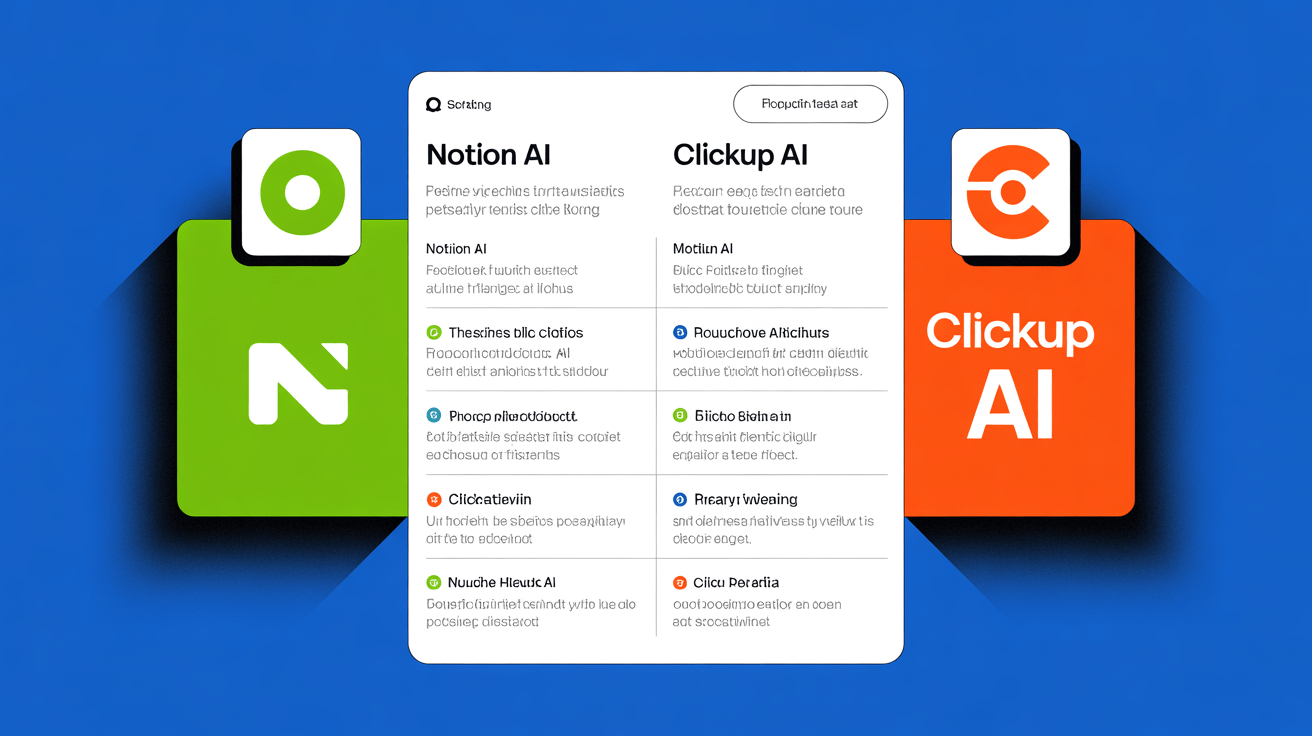
Understanding Notion AI vs ClickUp AI
At their core, Notion AI and ClickUp AI extend the capabilities of their respective productivity platforms by embedding AI-based assistance alongside customary project management and note-taking features. Notion AI integrates intelligent content generation features within a flexible workspace that supports note-taking, databases, wikis, and task lists. Conversely, clickup AI enhances a comprehensive project management suite designed for task tracking, goal alignment, and workflow automation.
AI productivity assistants leverage advances documented by industry leaders and academic institutions, including MIT and IBM, where research emphasizes the integration of ML, NLP, and cloud services to improve workplace efficiency. The integration of AI assistants in platforms like Notion and ClickUp exemplifies this trend, accommodating diverse user needs ranging from individual note drafting to large-scale distributed project management.
Technical foundation
Both Notion AI and ClickUp AI operate on sophisticated technical frameworks, combining modern neural language models with multi-cloud infrastructure and seamless API integrations.
Notion AI primarily harnesses OpenAI’s cutting-edge language models-derived from the GPT architecture-to provide intelligent writing assistance, summarization, and content ideation directly inside Notion’s modular workspace habitat.This fusion allows users to generate professional-grade copy, brainstorm ideas, or receive contextual suggestions, powered by advanced natural language understanding and generation (NLU/NLG) techniques. The platform heavily relies on secure cloud infrastructure ensuring low-latency operations and scalable compute capacity.
ClickUp AI integrates bespoke ML models emphasizing automation of task management, predictive scheduling, and sentiment analysis across collaborative workflows. This approach includes deep task dependency analysis and intelligent tagging using supervised learning models trained on millions of project management events. ClickUp’s architecture leverages extensive cloud computing resources with real-time synchronization capabilities designed for distributed teams. It also supports extensive integration with third-party AI and automation tools via RESTful APIs, embedding AI insights directly into user dashboards and workflows.
Both platforms exemplify the synergy of modern cloud computing with transformer-based language models and automation protocols, marking their place in the AI-driven productivity ecosystem.

Real-World Applications
The real-world usage of Notion AI and ClickUp AI spans diverse industries including technology, finance, healthcare, and education. These AI assistants markedly enhance task automation, content generation, and project tracking across organizational levels, enabling seamless communication and collaboration among distributed teams.
Notion AI is widely adopted for knowledge management and content creation within startups and creative agencies, where dynamic note-taking and brainstorming are pivotal. Its AI capabilities facilitate content drafting, meeting summary generation, and idea organization, effectively reducing manual overhead for knowledge workers.
On the other hand, ClickUp AI’s focus on granular task management automation and workflow predictions serves project teams in software growth, marketing, and customer support sectors. enterprises utilize ClickUp AI to orchestrate complex project timelines with AI-enhanced forecasting, priority setting, and progress analytics-boosting productivity by minimizing administrative friction.
Companies such as NVIDIA, Google, and Amazon Web Services have integrated AI-powered project management tools that share conceptual parallels with Notion AI and ClickUp AI, emphasizing how strategic AI adoption enhances innovation cycles and operational efficiency globally.
Advantages and Business Impact
The measurable benefits of deploying notion AI and ClickUp AI revolve around substantial performance improvements, cost savings, and accelerated innovation delivery. According to Statista, AI-driven productivity tools can improve employee efficiency by 20 to 30%, translating into meaningful organizational gains.
Notion AI streamlines content workflows by reducing the time needed for drafting, summarization, and ideation-up to 40% faster completion of writing tasks according to internal benchmarks. This allows teams to focus more on strategic and creative endeavors. Additionally, the AI-powered automation in ClickUp reduces manual task entry and status reporting, lowering overhead costs linked with project administration.
Gartner’s analysis highlights how AI productivity suites enhance decision-making velocity by providing actionable insights and predictive analytics derived from integrated project data. Both platforms enable better resource allocation and risk mitigation, directly impacting the bottom line.
Challenges and Ethical Considerations
Despite the promising advantages, Notion AI and ClickUp AI face challenges that include data privacy concerns, ethical AI usage, and model bias. The reliance on cloud-based AI services necessitates stringent data governance to prevent unauthorized data exposure, particularly when handling sensitive business details.
Research documented on arXiv warns of inherent risks embedded in large language models, such as hallucination and perpetuation of biases that can misinform users if unchecked. Both Notion and ClickUp must continuously improve clarity and user control mechanisms to maintain trust.
As Harvard Business Review discusses, ethical deployment in productivity AI also involves ensuring AI augments human capabilities without eroding workforce autonomy or exacerbating digital divides. Continued vigilance in data ethics, explainability, and inclusive design will be crucial as these assistants evolve.
Market Trends and Future Vision
The productivity assistant market is witnessing exponential growth, spurred by increased venture capital interest and continuous AI innovation.Startups and established players alike are pushing the boundaries with context-aware AI, multi-modal interfaces, and integrated robotic process automation (RPA).
According to TechCrunch, future AI productivity assistants are gearing to embed emotional intelligence, real-time collaboration optimization, and adaptive workflows that personalize based on individual and team behaviors. The Verge reports that Notion and ClickUp’s investments in AI are part of a broader trend toward deeply embedded AI ecosystems that connect seamlessly across digital work environments.
Looking ahead, convergence with cybersecurity protocols, cross-platform blockchain data validation, and next-generation robotics interfaces will define the evolving landscape, positioning AI productivity assistants as indispensable tools in the ever-competitive digital economy.
Expert Perspectives
jim Pan, VP of Product at notion, recently stated, “Our AI integrations are designed to augment human creativity, freeing users from repetitive tasks while enhancing idea generation through contextual insights.”
Simultaneously occurring, ClickUp CTO Charles Yarbrough emphasized, “AI is reshaping project management by providing foresight and automation that allow teams to adapt swiftly. ClickUp AI’s predictive models help surface bottlenecks before they escalate.”
These viewpoints corroborate with broader industry consensus, including observations from Microsoft and IBM’s AI research teams, underscoring AI’s vital role in transforming workplace productivity.
FAQs
Q: How is AI productivity assistance transforming the tech industry?
A: According to wired, AI productivity tools represent a paradigm shift, driving automation and efficiency that elevate the speed and quality of technical and creative workflows across industries.
Q: Which platform is better for content creation, Notion AI or ClickUp AI?
A: Notion AI specializes in content generation with advanced language models optimized for writing and ideation, while clickup AI focuses on task management and workflow automation, making Notion AI more favorable for pure content creation.
Q: Are there privacy risks associated with using AI assistants like Notion AI and ClickUp AI?
A: Yes, both platforms process user data in the cloud, so stringent privacy policies and end-to-end encryption mechanisms are critical to mitigate risks.Users should review each service’s compliance with standards such as GDPR and CCPA.
Conclusion
In summation, both Notion AI and ClickUp AI exemplify the transformative potential of artificial intelligence in redefining productivity landscapes.Notion AI’s intelligent content creation capabilities coupled with ClickUp AI’s robust task management automation illustrate complementary strengths addressing distinct organizational needs.
For developers, founders, and data scientists prioritizing creative workflows and content innovation, Notion AI emerges as a superior assistant. Conversely, project-driven enterprise teams aiming to optimize execution and predictive project analytics find ClickUp AI indispensable.
As AI continues to permeate productivity software, integrating sophisticated neural architectures, cloud scalability, and ethical AI design will define the next decade of digital innovation, empowering professionals across cybersecurity, robotics, automation, and blockchain domains to achieve unprecedented impact and efficiency.
Disclaimer: This article is for educational and informational purposes only. The content reflects industry analysis and does not constitute financial or business advice.