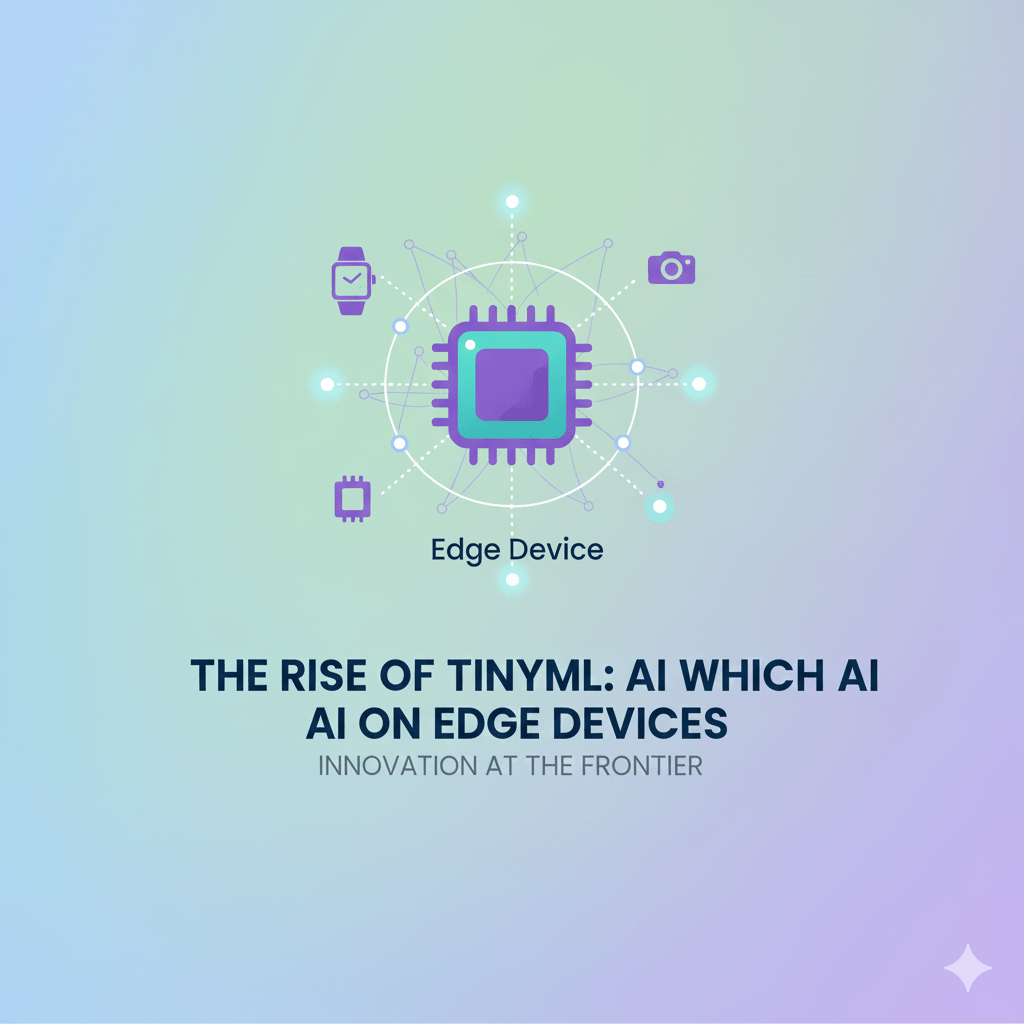
Teh expansion of artificial intelligence (AI) beyond traditional cloud infrastructures heralds a new paradigm in computation: TinyML. By embedding machine learning (ML) directly on resource-constrained edge devices, TinyML unlocks novel applications, reduces latency, lowers energy consumption, and reshapes how AI integrates into everyday technology. this article delves into the rise of TinyML on edge devices, unpacking its architectures, capabilities, challenges, and strategic implications for developers, researchers, and industry leaders.
the Fundamentals of TinyML: What Defines AI on Edge?
Understanding TinyML and Its Distinctiveness
TinyML represents a specialized subset of ML focused on deploying models on devices with extremely limited compute power-microcontrollers and low-power SoCs-often with only kilobytes of memory and minimal energy budgets. Unlike traditional AI workloads that require powerful CPUs or GPUs and network connectivity to the cloud, TinyML operates locally, enabling real-time decisions without latency incurred by data transit.
Core Enablers Behind TinyML’s Emergence
Several technological advancements have catalyzed TinyML’s ascent: innovations in semiconductor fabrication producing ultra-low-power microcontrollers (e.g., ARM Cortex-M, RISC-V cores), optimized neural network architectures like MobileNets and quantized models, and open-source toolchains such as TensorFlow Lite for Microcontrollers. Together, they form a cohesive ecosystem supporting the deployment of effective ML on chips embedded in sensors, wearables, and industrial devices.
Why Edge AI Matters: Benefits Beyond Raw Performance
Deploying ML at the edge via TinyML transforms product experiences with instant decision-making capabilities, enhances privacy by processing data locally, enables offline functionality, and substantially reduces cloud dependency-cutting operational costs and network load. Its submission diversifies from consumer electronics to healthcare monitoring and smart cities, providing scalable intelligence close to data sources.
tinyml Architectures: Navigating the Design Space of Edge Inference
Typical Hardware Constraints and Opportunities
Edge devices targeted by TinyML typically run on microcontrollers with clock speeds ranging from tens to a few hundred MHz, with as little as 8KB to a few MB of RAM and flash storage. These constraints impact inference architectures, necessitating compact models optimized for fixed-point arithmetic, sparse computation, and ultra-efficient memory access patterns.
Neural Network Architectures Tailored for TinyML
Architectural innovations such as depthwise separable convolutions (MobileNets), integer quantization, pruning, and knowledge distillation play a crucial role. Such techniques reduce model size and compute demands while retaining acceptable accuracy, allowing deployment on devices like ARM Cortex-M4, M7, or novel accelerators like Google’s Edge TPU’s microcontroller variants.
Runtime Frameworks and Toolchains
Progress in embedded ML runtimes simplifies deployment. TensorFlow Lite for Microcontrollers (TFLM), ARM’s CMSIS-NN, and uTensor provide optimized inference engines tailored to microcontrollers, supporting quantized model formats and hardware accelerated instruction sets. These frameworks handle model loading, runtime scheduling, and sensor integration in a tight resource envelope.

Power Efficiency and latency: Key Metrics Driving TinyML Adoption
Benchmarking Latency in Real-World conditions
latency is pivotal for applications such as gesture recognition or anomaly detection where milliseconds matter. TinyML models typically achieve inference latencies from sub-10ms to around 100ms, depending on model size and MCU clock frequency. Low latencies enable responsive prompt actions and critical safety functions in embedded systems.
Energy Consumption Considerations
Power budgets on edge devices are often limited to mW or µW ranges with stringent battery life requirements. Efficient model deployment and runtime optimization directly correlate to device longevity. Techniques such as duty cycling sensors, ultra-low-power modes during idle, and hardware acceleration are instrumental in meeting energy targets.
KPIs for Evaluating TinyML Deployments
Programming Workflow: From Dataset to Edge Deployment
Data collection and Annotation for TinyML Models
Given TinyML’s focus on edge scenarios, datasets must represent real-world device usage conditions. Data pre-processing and augmentation tailored to sensor modalities (audio,accelerometer,environmental) are essential for robust model training and subsequent deployment.
Model Training and Optimization Pipelines
Using frameworks like TensorFlow, PyTorch, and specialized TinyML toolkits, developers prune and quantize models down to meet device constraints. Automated pipelines convert floating-point models to int8 or int4,reducing size and power without sharply sacrificing accuracy.
Firmware Integration and Over-the-Air (OTA) Updates
After converting the model into a format suitable for microcontroller execution (e.g., flatbuffer for TFLM), the model binary integrates with device firmware. OTA update mechanisms ensure models can be iteratively improved post-deployment, a vital element in continuously evolving TinyML products.
security and Privacy Challenges in On-Device AI
Reducing Attack Surface by Local Inference
By processing data locally, TinyML reduces exposure to cloud-based data breaches and network eavesdropping.Sensitive data such as biometric patterns or environmental readings need not leave the device, enhancing privacy compliance.
Threat Modeling for TinyML Systems
However, edge devices can be physically accessible and more vulnerable to hardware attacks, tampering, or firmware manipulation. Secure boot, encrypted models, and hardware-isolated key storage are recommended mitigations.
Balancing Model Explainability and security
TinyML’s tight compute budgets mean less capacity for embedded security analytics.Embedding lightweight anomaly detection or trust-monitoring frameworks on device can definitely help identify misuse or data corruption while maintaining system integrity.
Current and Emerging Use Cases That Are revolutionizing Industries
Healthcare Wearables and Biometric Monitoring
TinyML enables continuous monitoring on low-power medical devices-e.g., arrhythmia detection from ECG sensors where battery longevity and immediate alerting are crucial. It supports personalized medicine by embedding intelligence in wearable health tech.
industrial IoT: Predictive Maintenance at the Edge
Smart manufacturing uses TinyML models on embedded sensors to detect vibration anomalies or equipment wear in real-time.This on-device intelligence eliminates costly communication overhead and enables rapid intervention.
Consumer Electronics and Smart Home Devices
Voice command recognition, gesture control, and security cameras increasingly run TinyML models on-device, allowing fast latency responses and enhanced user privacy without reliance on cloud services.
Challenges and Pitfalls in Deploying TinyML Solutions
Model Accuracy vs. Resource Constraints Trade-offs
Achieving desirable accuracy with shrink-wrapped model sizes remains a core difficulty. over-aggressive quantization or pruning may degrade model performance, especially for complex tasks, necessitating careful tuning and domain-specific customization.
Debugging and Observability Limitations
Debugging AI models on tiny devices with limited IO and logging capacity is inherently challenging. Profiling tools for embedded inference and real-time monitoring are less mature compared to cloud ML workflows, impeding rapid iteration.
Hardware Fragmentation and Portability Issues
The microcontroller ecosystem is highly fragmented, with many vendors, instruction sets, and OS flavors. Porting TinyML models across devices or integrating heterogeneous sensors requires significant engineering effort and robust abstraction layers.
Strategic Industry Trends Shaping the Future of TinyML
Standardization and Community Growth
Frameworks like TensorFlow Lite Micro and initiatives such as the TinyML Foundation promote best practices and shared tooling, encouraging interoperability and knowledge exchange vital for industry maturity.
Hardware Innovation and Custom accelerators
Emerging ultra-low-power AI accelerators-frequently enough embedded as co-processors-are augmenting traditional MCUs to manage more sophisticated models efficiently, pushing the boundaries of edge capabilities.
Investment and Ecosystem Expansion
Venture capital influx into startups focused on TinyML hardware, software, and applications signals increasing confidence in the sector’s growth trajectory and potential commercial impact over the next decade.
the Essential APIs and Frameworks Powering tinyml Today
TensorFlow Lite for Microcontrollers
The most widely adopted runtime for TinyML, TFLM supports multiple microcontrollers and offers a range of tools for converting full-fledged TensorFlow models into deployable binaries. The API facilitates sensor data integration, model invocation, and hardware abstraction.
ARM CMSIS-NN
ARM’s CMSIS-NN library provides highly-optimized neural network kernels tailored to Cortex-M processors, accelerating convolutional and fully connected layers efficiently, reducing inference time and energy consumption.
Edge Impulse Platform
Edge Impulse offers an end-to-end TinyML development ecosystem that combines data ingestion from real devices, model training, and seamless deployment pipelines, simplifying TinyML development for engineers at all levels.
How Startups and Giants Are Capitalizing on TinyML Potential
Leading industry Players and Partnerships
Big companies like Google, ARM, and Qualcomm have invested heavily in TinyML toolchains and silicon, while startups are innovating in niche domains such as ultra-low-power sensor fusion, embedded speech recognition, and secure tinyml platforms.
Horizontal vs. Vertical market Strategies
Horizontal approaches build generic, modular TinyML platforms and tools, whereas vertical applications focus on domain-specific use cases such as agriculture or healthcare. Both strategies offer unique opportunities and risks in product-market fit.
Investor Perspective and Market Sizing
Market research forecasts TinyML’s compound annual growth rate (CAGR) exceeding 30%, driven by IoT proliferation and AI democratization trends. Investors prioritize startups with scalable IP, hardware-software synergy, and demonstrable efficiency gains.
Learning resources and How Developers Can Get Started with TinyML
Recommended Online Courses and Tutorials
Resources such as the TinyML Foundation’s official portal and TensorFlow Lite Micro tutorials offer hands-on guides and sample projects to accelerate learning.
Community and Open Source Contributions
Participating in forums like Reddit’s TinyML subreddit or contributing to open-source projects builds expertise and access to growing networks of collaborators.
Building Your First TinyML Application Checklist
- Identify a simple sensor-based classification or detection task.
- Collect and preprocess sample sensor data relevant to your task.
- Use TensorFlow lite Micro to train and quantize a lightweight model.
- Integrate the model binary into MCU firmware using appropriate SDKs.
- Deploy on hardware like an Arduino Nano 33 BLE Sense or Raspberry Pi Pico.
- Test inference accuracy and measure latency and power consumption.
- Iterate with pruning, quantization, or architecture adjustments to optimize.
Long-term Implications of TinyML on the AI and iot Industry
Towards Fully Autonomous Edge Ecosystems
As TinyML matures, networks of smart edge devices will not only infer but actively learn and adapt, collaborating peer-to-peer without cloud mediation. This could redefine AI architecture towards decentralized intelligence.
Environmental Impact and Sustainability Considerations
By reducing cloud compute demand and associated energy footprints, TinyML contributes to greener AI implementations, aligning with corporate environmental, social, and governance (ESG) goals globally.
Integrating TinyML into Next-Gen Technologies
Future intersections with 5G/6G connectivity, blockchain for device trust, and neuromorphic computing point to a rich convergence, positioning TinyML as a keystone of evolving digital ecosystems.